Last weekend, I wandered down to the shore and gingerly stepped into the water, an act I instantly regretted. The cold hit my foot, and I yanked it out before I could even gasp. This past winter in Provence was harsh, with temperatures dropping into the single digits, high winds, and record rainfall. Swimming in the Mediterranean Sea is an integral part of my life, but the water was bitterly cold.
Retreating to a rock out of reach of the waves, I watched the sea settle into a rare stillness. The sky began to turn pink, and the color reflected so clearly on the surface that sea and sky seemed to blend together. Without warning, a band of fish—maybe thirty of them, each several inches long—burst out of the water directly in front of me. They rose together in a smooth arc and passed by just as the last ray of sunlight caught them, turning their bodies into pure silver. For a brief moment, they looked like light itself, and then they were gone, slipping back beneath the surface as quietly as they had appeared. I stayed a long moment, hoping they would appear again.
Before darkness fell and the evil jellyfish could sneak out to attack me, I made my way back to shore and walked home. Lent was on my mind. Growing up, Fridays meant fish, notably salmon patties. Why take perfectly good salmon and turn it into a fried cake with some suspicious-looking vegetables? No doubt, it is considered a gastronomic delight these days, but as a child, it seemed like a punishment. Lent also meant giving something up for forty days. It wasn’t my favorite time of year.
When I left for college, my faith slipped away, and I didn’t miss it. Lent became a distant memory of rules and denial. That all changed one spectacular day in Lourdes a few years ago. Since then, I’ve wondered about the practices surrounding this period before Easter.
On Fridays, Catholics are called to abstain from meat, traditionally considered a luxury, as a form of penance. The suggested alternative is fish. The problem is that, with the exception of salmon cake, I love fish, and eating it on any day of the week is not a sacrifice but rather a treat.
As I replayed the moment by the sea with the silver fish in my mind, I remembered what my Aunt Sarah taught me. In Greek, the word ichthys (ἰχθύς) means “fish,” but for early Christians it carried far greater weight.
Iēsous (Jesus), Christos (Christ), Theou (of God), Yios (Son), Sōtēr (Savior)
The word Ichthys is actually a full statement of belief: “Jesus Christ, Son of God, Savior.”
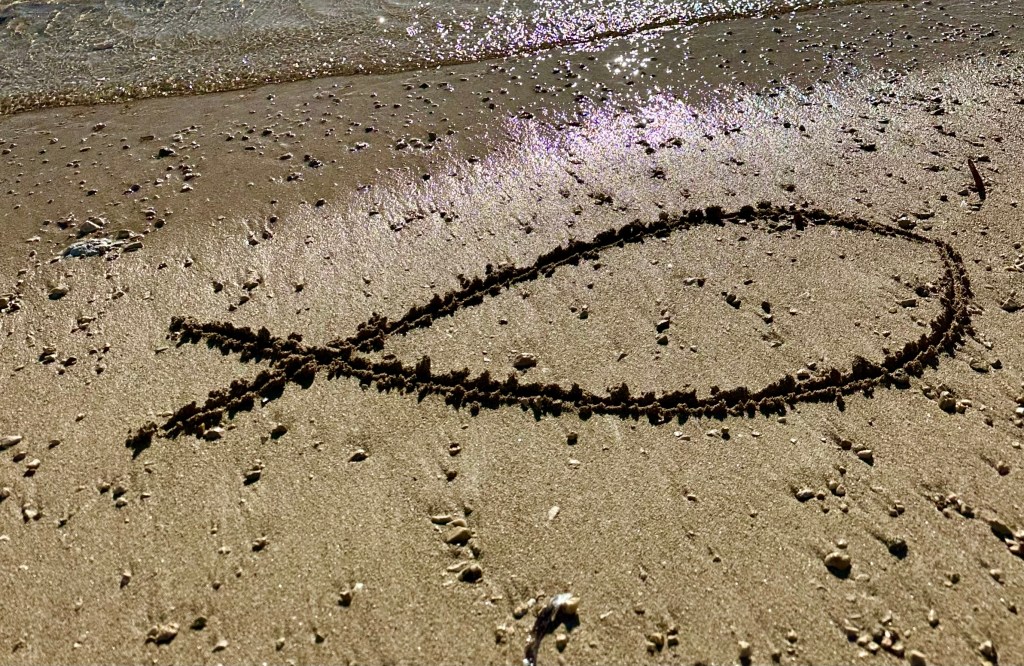
I decided a little research was needed. After the crucifixion and resurrection of Jesus, openly declaring yourself a Christian could have cost you your life. Discussing theology in public places was dangerous, so believers learned to recognize one another quietly and discreetly. A fish scratched into a wall, drawn in the dirt, or carved into stone appeared harmless to anyone who didn’t know its meaning. One person would draw a curved line in the sand, and if another completed the shape, both knew they shared the same faith. The fish was a simple statement of belief in Christ.
The symbol grew naturally out of the life of Jesus. His first disciples were fishermen, and much of his ministry was carried out near the Sea of Galilee. He fed crowds with bread and fish and spoke of his followers as fishers of men. Early Christians did not focus on the cross right away. The cross was an instrument of execution, loud with fear and power, a symbol of oppression. The fish, by contrast, was humble, familiar, and quiet.
The following morning, Sammy and I wandered down to our bustling village fish market. While he scouted for cats, I watched people with baskets line up, eagerly waiting for the stalls to open with the day’s catch.
As I watched each person being greeted by the vendor, it occurred to me that perhaps Lent is an invitation open to anyone, regardless of belief, to eat fish. The teachings of Jesus were simple and meant to be lived: inclusion, compassion, patience, kindness, love, and paying attention to the people right in front of us. Eating fish becomes less about what’s on the plate and more about what values we choose to consume. What we repeatedly nourish ourselves with eventually becomes part of us. As they say, you are what you eat!
But what about the practice of giving something up? Jesus made the ultimate sacrifice on Good Friday. He knowingly and willingly offered His life for us, and the Father gave us His only Son. If we strive to be more like Jesus, then it makes sense to give up something, but not for the sake of sacrifice alone. Maybe it’s about removing things to make space for what truly matters.
Giving up wine, chocolate, or coffee would only make me crabby, and I don’t think spiritual growth is supposed to make the people around me miserable. It would definitely not spread Jesus’ message of patience and love.
No, what I choose to give up must have a deeper meaning. Maybe I could make a conscious effort to give up the judgments that slip in before I know the whole story or the impatience that frustrates me when things don’t move at my pace. I could let go of the small things that quietly pull me away from kindness: the sarcasm that cuts, the little grudges that linger, and the mental clutter that keeps me focused on what’s wrong instead of what’s good in my life.
I have no illusions. I’ll just pick one, and it will be far from perfect, but I will try. Even if I can reduce one tendency just a bit over forty days, there’s a chance it might continue beyond Lent. That would not be true about wine and chocolate. The minute Easter arrived, I would be armed with a corkscrew, and those cute, gold-foiled Lindt bunnies wouldn’t stand a chance.
Shifting on the bench, I observed Captain Fred, pastis in hand, deeply engaged in conversation with Sylvie, the oyster vendor. He gestured animatedly, dangerously tilting the milky yellow drink, while the salty sea breeze mingled with the sharp brine of freshly shucked oysters. A grizzled old man whose eyes held memories of the years at sea quietly observed the crowd, every now and then drawing on his pipe. Everyone has a different way of expressing themselves. For some, the steady rhythm of fasting and ritual, passed down through centuries, carries profound significance. These practices deserve respect, not dismissal. One person’s way of practicing faith doesn’t negate another’s. There has never been, nor will there ever be, a single true path.
Sammy settled at my feet, satisfied that the zone was cat-free. I reached down to pet him and noticed a yellow smiley face painted on a nearby paving stone, one I had somehow never seen despite walking past it a thousand times.
It’s not just about giving things up. There are things I need to add to my life this Lent and far beyond. Notably, more attention and living in the moment. The other evening, if my mind had been elsewhere, focused on what I had to do next or on the overwhelming noise and anxiety of the world, I would have missed those beautiful silver fish, catching and reflecting back the light of creation. God often appears without announcement.
Fish still matters. Not just as a tradition or a stand-in on Fridays, but maybe to remind us to return to the essence of what Jesus actually taught and lived. Love, compassion, mercy, tolerance, inclusion, gratitude, and hope. A faith that shows up in how we live, not how loudly we argue for it. The reason for eating fish on Fridays is far deeper than I thought and perhaps I should eat it more often.
I hope you like my fish drawing in the sand. It took me a while. The first one was washed away by a rogue wave, and one of Sammy’s doggie friends ran through the second one. The third turned out ok.
Discover more from Amy L. Griffin
Subscribe to get the latest posts sent to your email.
 Amy L. Griffin