The Firefighters, the Priest, and the Human Chain of Notre-Dame
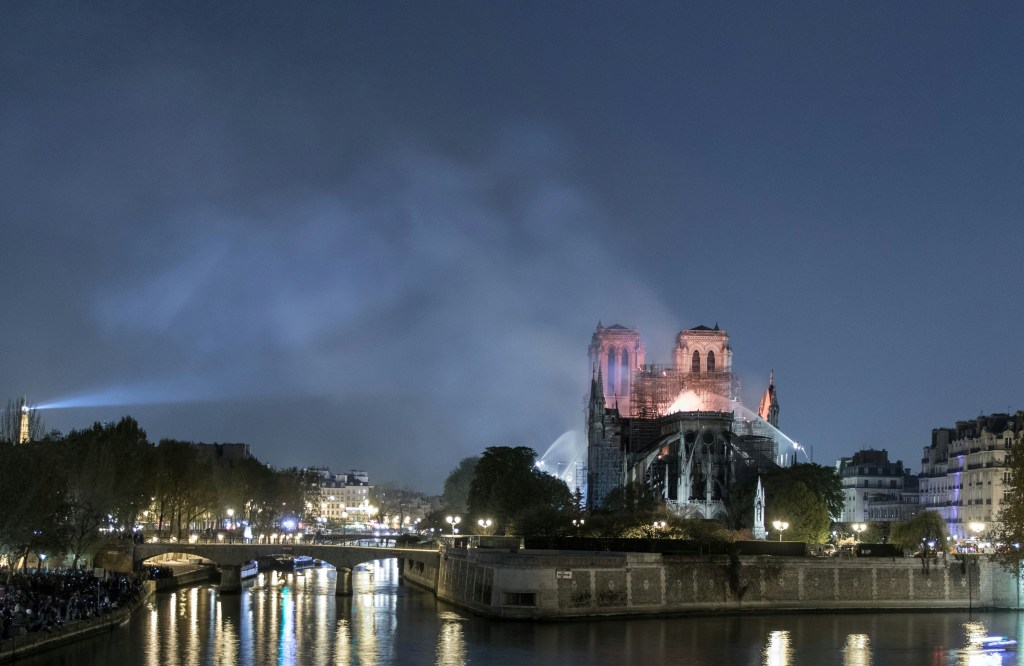
At 6:18 pm on April 15, 2019, an alarm triggered inside Notre-Dame Cathedral, and within an hour, an orange gash split the Parisian sky. The eight-hundred-year-old grid of medieval oak timbers in the attic, called The Forest, had become a massive tinderbox.
By 7:50 PM, the cathedral’s iconic spire groaned, snapped, and crashed directly through the stone vaults, sending a violent shockwave of embers, burning timber, and molten lead raining down into the pitch-black nave.
Outside, thousands stood in stunned silence along the banks of the Seine, weeping openly or dropping to their knees to sing the Ave Maria. The world watched as one of France’s religious and cultural symbols went up in flames.
But Father Jean-Marc Fournier did not stand praying desperately to the sky. The chaplain of the Paris Fire Brigade was no stranger to crisis. He had comforted victims of the tragic 2015 Bataclan terrorist attacks and served alongside soldiers in Afghanistan, and tonight his battlefield was the burning cathedral of Notre-Dame. Armed with fierce determination, he put on his gear and braved the roaring flames, running directly into the heart of the disaster alongside an elite squad of firefighters.
His first mission was to save the Blessed Sacrament, the Eucharist, housed in the ciborium, a cup-like metal vessel that held consecrated Communion hosts. Just before he carried the Blessed Sacrament out to safety, he paused amid the falling debris to give a formal blessing, and at the moment he raised the host to bless the cathedral, fire crews managed to stop the fire from consuming the northern bell tower.
After ensuring the safety of the Living Christ, Father Fournier ran to the aid of Christ the Crucified. The cathedral’s Treasury held its most sacred treasure: the Crown of Thorns, a relic believed to have been worn by Jesus Christ during His Passion and given to King Louis IX of France in the 13th century.
When the rescue team breached the Treasury, they hit a heart-stopping obstacle. In the chaos of the evacuation, the keys and security codes to the massive safe housing the Crown and other treasures were nowhere to be found. With literally seconds ticking away and toxic dust filling the air, the firefighters used heavy rescue tools to force the safe open. Inside were His Crown, encased in crystal and gold, a piece of the True Cross, a 3.5-inch Holy Nail, the 13th-century linen Tunic of Saint Louis, and an array of centuries-old chalices and monstrances.
Spontaneously, firefighters, police officers, municipal workers, and Red Cross volunteers formed a human chain, passing the inestimable treasures hand to hand out of the burning cathedral into the courtyard, where they were loaded into vans and rushed to safety.
Firefighters and crews worked through the night, and by late morning the following day, the fire was extinguished, just 15 hours after it began.
Seeing the first photos, people spoke in awe of miracles. The towering golden cross on the high altar, officially named Croixe et Gloire (Cross and Glory), stood triumphantly intact amid piles of charred rubble and ash. The Pietà marble statue of the Virgin Mary cradling Jesus remained untouched. In 1638, King Louis XIII consecrated France to the Virgin Mary, promising a grand remodel if he were blessed with a son. The birth of the future Louis XIV, the Sun King, put the vow into motion, culminating in the creation of the Pietà.
High above the destruction, the three monumental 13th-century rose windows shone unbroken, defying physics in a staggering way. Stained glass is notoriously fragile and is held together by delicate lead joints. Inside, temperatures reached three times the melting point of lead.
Did an army of angels swoop down from the heavens to lift up the massive cross and the Pietà out of the fire? Did their wings shield the glass windows and their tears dampen the fire? Maybe.
Or maybe those heavenly forces came to aid those fighting the fire. Over 400 firefighters, a human chain of 100 people to save the treasury, and countless others worked through the night. Perhaps angels were there, giving each of them the extra strength to keep going when their muscles cramped and they were ready to fall from fatigue.
Perhaps the Holy Spirit guided the Paris Fire Brigade to focus their hoses on protecting the stone gables around the rose windows and cooling the nearby wooden structural frames so the glass would not shatter under direct water pressure.
In the smoky, suffocating darkness, when each hand in the human chain touched the Crown of Thorns, the Holy Nail, and the True Cross, perhaps each heard Jesus whisper Do not be afraid. Have courage, for I am with you. Because He was, they were literally touching those things He once touched Himself.
And then there is Father Jean-Marc Fournier. In French, his last name means ‘a baker’, specifically, the medieval keeper of a communal public oven used to bake bread for others. But that day, Father Fournier did not tend the flames. Instead, he ran directly into a thousand-degree furnace to rescue the Bread of Life and the Crown of Thorns.
After the fire, he recalled that despite the raging inferno above, an eerie, absolute silence met him as he entered the nave, broken only by falling molten lead. He told reporters that, in an act of faith, he asked Jesus, whom he felt to be truly present in the Blessed Sacrament, to fight the flames and preserve the building.
Father Fournier told reporters that the Crown “does not belong to Christians alone, but to all of humanity,” as a bridge of universal cultural history. He called the Crown of Thorns “the key to the opening of heaven” and the ultimate tangible proof of Christ’s Passion. He noted that as humans, we naturally seek physical, touchable reminders of what we believe. “We sometimes mock Saint Thomas who wanted to touch Christ’s wounds… but in certain circumstances, we need tangible signs of faith.”
Each person must come to their own conclusions about the miracles. I’ve seen miracles that were God and God alone, with no human intervention. In fact, I experienced one myself. But with Notre Dame, I’m not convinced that divine intervention swooped down majestically from the sky to save the day. Rather, I think God moved through the firefighters’ bravery, Father Fournier’s fearless resolve, the human chain that saved the Crown, the crowds singing on the banks of the Seine, and the millions praying around the world. That night, heaven and earth met through human hands.
Photo credit: Nivenn Lanos
Sources for the quotes of Fournier: Grand Magisterium – Vatican, Summer 2019, Interview of Fournier by Solène Tadié
Discover more from Amy L. Griffin
Subscribe to get the latest posts sent to your email.

