The hot, sultry, uncomfortable days from mid-July to mid-August, known as the Dog Days of Summer, are often linked to Sirius, the bright Dog Star in the constellation Canis Major. When Sirius rises in the Northern Hemisphere, the ancient Egyptians believed its intense glow, combined with the sun’s rays, amplified the heat and caused the year’s hottest and most oppressive days.
However, another legend, recounted by Hyginus, is much less known and far more haunting.
Long ago, Dionysus, the god of wine and revelry, wandered through the Greek countryside beneath a blazing summer sky. Dust rose from the road beneath his sandals, and cicadas sang loudly from the olive trees. By the time he reached a small farming village, the heat had settled heavily on him, and his throat was dry. There he encountered a farmer named Icarius.
Dionysus asked the farmer for something to drink. Though Icarius possessed little, he welcomed the stranger without hesitation and offered him a bowl of cool milk, which the god accepted gratefully. Hospitality was sacred among the Greeks, and Dionysus was pleased by the farmer’s generosity.
As a reward, he presented Icarius with a grapevine unlike any mortal had ever seen. More than that, he revealed a divine secret, the art of making wine.
Icarius planted the vine and carefully tended it through the seasons. The vine flourished beneath his care, and when the grapes ripened, he followed Dionysus’s instructions and produced a wine of extraordinary quality. Proud of his success, he shared it with his neighbors on a summer evening.
At first, they marveled at the drink. It warmed their bodies and loosened their tongues. Laughter rolled through the village square. Songs drifted into the evening air while friends embraced one another. They congratulated and lavishly praised Icarius.
As the cups kept coming and going, a strange shift took hold. The ground seemed to ripple beneath them, faces blurred, and words tangled. Unsteady legs gave way, and villagers stumbled and fell. The world seemed to double and spin, a foggy chaos of sounds and images.
The villagers could not understand what was happening to them. Panic and fear soon transformed into suspicion, which hardened into violent anger. Convinced that Icarius had poisoned them, they turned on the very man who had shared his bounty. In a frenzy of drunken rage, they seized him and hurled him into a well, leaving him there to die.
Days passed, and when Icarius failed to return home, his daughter Erigone became consumed with worry. With her faithful dog Maera, she set out across the countryside in search of her father. Together, dog and mistress wandered fields, hillsides, and lonely roads beneath the relentless summer sun.
It was Maera who found him. The loyal dog led Erigone to the place where her father lay buried. When she discovered the truth, grief overwhelmed her completely. Her sorrow grew so immense that it shattered her reason. Unable to bear the loss, she climbed a tree near her father’s grave and hung herself.
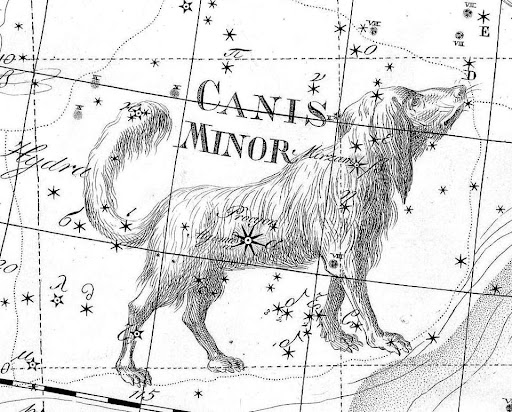
Maera refused to leave. She remained beside the graves of Icarius and Erigone, guarding them through the changing seasons until age and grief finally claimed her as well. As a reward for her unwavering devotion, Maera was placed among the stars, becoming the star known as Procyon in Canis Minor, the Lesser Dog.
Dionysus was enraged by the fate of his friend and punished Athens with plague and suffering. Yet the god’s anger was not the worst vengeance unleashed upon mankind. Maera herself made a vow. From her place in the heavens, she swore that humanity would pay for what had been done to Icarius and her beloved Erigone.
Each summer, from her place among the stars, Maera inflicts on the world below the same madness that had claimed her mistress. As Procyon rises alongside Sirius from early July through mid-August, the season enters its most miserable stretch.
These are the days of Maera.
Streams shrink between their banks, and the earth splits into long, thirsty cracks. The air is hot and sultry. Crops bow beneath a pitiless sun that hangs over the world like molten bronze. Relentless heat settles into the soul and refuses to leave. Fever and disease spread, food spoils, and violent thunderstorms erupt suddenly from distant horizons before dissolving into suffocating humidity. Sleep offers little comfort, as the nights bring no cool breeze. Depression and lethargy settle over the earth. Work becomes a burden, and tempers flare. Even the simplest tasks seem strangely difficult beneath the season’s oppression. During the Dog Days of Summer, elders say that morning dew can poison an open wound, misfortune shimmers maddeningly in a wavering haze above sun-scorched fields, and even snakes go blind.
The gods placed Maera among the stars as an honor, but the old storytellers whisper that it was no blessing. It was a curse. For what greater torment exists than to love so relentlessly that not even death can loosen its hold? From the heights of the heavens, she watches the centuries flow past like rivers, yet she remains bound to loss and grief. The names of kings are forgotten, and temples crumble into dust, yet Maera remembers. She mourns with the grief of the faithful and burns with the fury of the wronged. Each year, when the Dog Days descend upon the world, the ancients say it is not the stars alone that blaze overhead, but the heart of Maera, undiminished by time, shining with an ancient sorrow that eternity itself cannot quench.
Discover more from Amy L. Griffin
Subscribe to get the latest posts sent to your email.
 Amy L. Griffin