Saint Francis of Assisi is one of the world’s most beloved saints. We picture him surrounded by birds, walking through the countryside, and being one with creation. He is remembered for his joy, humility, simplicity, and love for the poor.
Imagine we invited him over for dinner, and to our amazement, he accepted! Naturally, we want everything to be just right. After some research, we learned he wasn’t a vegetarian and that shrimp pie was among his favorite meals. Shrimp linguine seems close enough. The house is spotless, the table is set with our best china, and we even lit a few candles. All the guests have arrived and are eager, although a bit nervous, to meet this great saint.
We hear a soft knock and open the door to find a thin man with dark hair and a sparse beard standing there, wearing a patched brown tunic tied with a simple rope and dusty sandals that have clearly seen many miles. Yet what strikes us most are his eyes. They are full of genuine warmth that immediately puts everyone at ease.
“The Lord give you peace,” Francis says.
Dinner proceeds beautifully. We discuss faith, family, prayer, our desire to visit Assisi, and the struggles of contemporary life. Francis eats with gratitude and listens much more than he talks. Eventually, we inquire about his transformation from a wealthy playboy to a humble, traveling friar who gave up all his possessions to follow Christ.
He smiles and says,
“It didn’t happen overnight. One or two moments set things in motion, but the rest of my life was spent in conversion, which is essentially the process of moving towards God. We all make mistakes along the way and I made a lot! But we must keep going. Following Christ is a dynamic journey and never a static process.”
After a few moments, the conversation shifts to us, and we begin listing our good deeds. Since he is a saint, we want to make a good impression. We mention volunteering at church, supporting charities, and visiting the poor and sick. We talk about bringing meals to families in hardship and assisting with community projects. As we speak, our list grows. We’ve been engaged in these activities for years. We find joy in them, and they give us a sense of purpose.
Francis listens with genuine interest.
“That is wonderful,” he says warmly. “The world needs such goodness.”
The compliment feels reassuring, as if he has confirmed that we are, in fact, doing a respectable job of following Christ.
Then he learns forward, looks at each of us and asks earnestly,
“Are you still being challenged?”
In the silence that follows, we glance at one another across the table. We are busy and committed, but are we challenged? Service and good works have become part of our lives, part of who we are, and there are always new people to serve. Does Francis think we should do more? Our schedules are already full.
After a moment, Francis smiles.
“Would you show me the rest of your home?”
He gestures for everyone to come along. We start in the living room, where he stops in front of family photos and inquires about the people in them. He examines a painting above the fireplace while we share how we discovered it and the lengthy discussion we had before concluding it was just the right piece for the room.
Francis glances at a cabinet showcasing crystal wine glasses, elegant china serving platters, and festive holiday dishes arranged with great care. In the kitchen, his attention settles on an appliance on the counter. Next to it is a gleaming set of cooking knives, so sharp that we are afraid to use them. A white ceramic container, decorated with yellow flowers and blue farm animals, holds a variety of salad servers, large wooden spoons and spatulas, a soup spoon, and a heavy pewter ladle.
“You must really like soup!” He exclaims, “But what is this?”
“It’s a breadmaker.”
“Oh, the bread tonight was excellent,” he says. “Did it come from this?”
“No,” we admit. “We bought it from the specialty bakery in town.”
A slightly confused look crosses his face.
“When was the last time this made bread?”
None of us can remember, though we are fairly certain it worked at least once during a brief season of optimism.
As we walk through the house, we begin to notice, perhaps for the first time, all our furniture, throw pillows, surfaces covered with knick-knacks, small bowls, keepsakes, books, and decorations on the walls. Francis pauses at the hallway closet and asks,
“May I?”
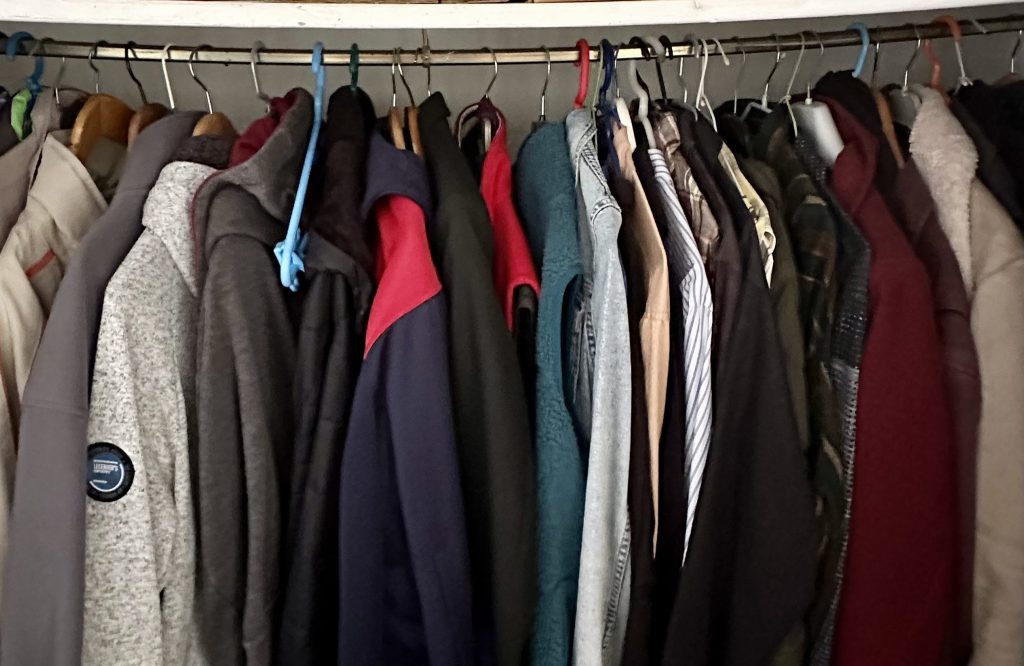
Inside are coats, scarves, hats, shoes, and a pile of reusable shopping bags. The upper shelf is stacked high with boxes.
“Are you up for a challenge?” he asks.
We’re all a little wary, but remembering that this is the great Saint Francis, we agree.
“Choose a few things to give to the poor and marginalized.”
Whew, this is manageable, and besides, we’ve been eager to declutter. We take out an older winter coat that’s still in good shape but has been relegated to backup. Next comes a sweater that’s become less appealing over the years, though it’s warm and someone might like its unusual pattern and color combination. We include a couple of long-sleeved shirts for outdoor work, along with a fleece vest and a pair of beautiful shoes we wore once or twice, but they really hurt our feet.
On the top shelf, we spot a beautiful pair of soft leather gloves purchased during a trip to Europe. What a wonderful experience! Such great memories. We make a mental note to wear them when the weather gets colder. Next, we find a foldable umbrella given to us as a gift at the office holiday party. The blue unicorn pattern suggests our colleague didn’t think highly of us. However, it’s brand new, still has its tag, and would definitely be useful to someone. We place it with the other items on the chair by the closet.
Next, we examine a fancy pure silver picture frame carefully. It was very expensive, but it has a tiny chip on the back left-hand corner that is barely noticeable. Whoever finds this in a second-hand shop will be quite lucky. Inside a shoebox, we discover a long-sought stack of CDs of our favorite music that we have been searching for for 10 years. We should label that box for easier retrieval later. Next to it is a small box. Blowing off the layer of dust, we open it to reveal our grandmother’s china teacup set.
Unwrapping one of the cups, we are flooded with memories of family gatherings, lazy afternoon conversations, and our grandmother’s laughter drifting from the kitchen. Carefully, almost reverently, we wrap it again and return the box to the shelf with a nostalgic smile.
We have assembled what feels like a generous pile of items that poor and underprivileged people could use. Francis studies the collection, then points to the sweater.
“Would you give that to Jesus? If He were standing right next to us, right now, would you place it in His outstretched hand?”
Everyone falls silent, uncertain of what to do or say. Internally, we think, no, of course not—not to Jesus. Slightly panicked, we ponder what the modern equivalents of frankincense and myrrh might be. Perhaps an iPhone or our Wine of the Month Club subscription?
If Christ Himself were standing in our hallway, we certainly wouldn’t hand Him the spare coat or the ugly sweater. Instead, we’d quickly find the super jacket we bought last spring and haven’t worn yet, along with the lovely cashmere blanket reserved for guests. And maybe that beautiful vase…
Interrupting our thoughts, Francis says gently, without the slightest hint of accusation.
“The difficulty is that Jesus identified Himself with the poor. He did not say, ‘What you do for them, you do for them.’ He said, ‘What you do for the least of these brothers and sisters, you do for me.'”
He looks at our pile of items once more, then motions for us to go back to the living room. As we pass through the kitchen, he points to the breadmaker and says cheerfully,
“You could give that thing away, you’re not using it.”
We reply without thinking, “The poor need basic necessities, not fancy gadgets.”
He says softly, almost to himself,
“What’s more essential than bread?”
Feeling slightly awkward, we settle in the living room with coffee and a decadent chocolate cake with white cream frosting, served on pretty glass dessert plates with small silver dessert forks.
Francis bites into his cake, waves his mini fork happily, and smiles broadly. “Delicious!” he exclaims, then sets the plate down. “Please don’t think I’m judging you. I’m not. No one can ever judge anyone but themselves. I chose radical poverty, but that’s not everyone’s calling or path.”
He chuckles as we all breathe an audible sigh of relief.
“Listen, I didn’t give away everything all at once. It was a process. First, I gave money to poor beggars without even thinking of them as people. It was a simple gesture, and they were just a concept. Then, I gave my fancy new armor and horse to a knight down on his luck. Finally, I stood before my father and the bishop, took off all my clothes, and denounced my inheritance. But that wasn’t the end, not at all. It was another step on my journey.”
He looks pensive, then continues,
“Possessions themselves are not bad or evil. The problem is holding on to them so tightly that you cannot imagine letting them go if Christ Himself asked. That’s when possessions possess you. They stand between you and God.”
As the evening draws to a close, Francis notices an empty cardboard box hastily stashed behind a door. He picks it up and sets it in the middle of the room.
“Write ‘Saint Francis Challenge’ on one side and Jesus on the other.”
“What goes in it?” we ask.
“Not the things you were already planning to give away, and definitely not that sweater!” He smiles, then continues, “Choose things you have absolutely no intention of giving away. Things you would gladly place in the hands of Christ Himself. Things that are both beautiful and useful. The poor deserve beauty as well.” He pauses. “Things that have a claim on your heart.”
Before leaving, he asks us for the recipe for our shrimp linguine, mentioning that there is an All Saints Potluck next week. Jesus always takes care of the bread and wine, but sometimes it’s a challenge to find new things to eat after 800 years in Heaven.
He thanks us and says, “You are all doing wonderful things, but maybe it’s time to get moving again. The moment we feel secure in our spirituality is dangerous because we stop challenging ourselves and stop growing. One doesn’t arrive at holiness and discipleship because it’s a never-ending journey.” With a warm, genuine smile, he says, “The Lord give you peace.”
After the front door closes, we return to the living room to finish that delicious cake. The dessert forks seem ridiculous now. We replay everything that just happened. The discussion shifts to something we talk about all the time. Surrendering ourselves to God—our time, our will, even our decisions. Let go, and let God. However, surrendering our valued possessions is a completely different matter. Was Francis serious? Surrendering our precious things to God isn’t something we have ever considered an act of service. Our friend, who recently joined an online Bible study, quotes Matthew: “For where your treasure is, there your heart will be also.”
We feel slightly annoyed at being quoted Bible verses and silently vow never to invite that friend again. After a moment, we acknowledge that we may have grown overly comfortable with our current services and gestures. But are we really willing to go further? Christ isn’t asking us to set aside another Wednesday evening to volunteer. We already do that. Saint Francis is challenging us to do something more difficult. Surrendering possessions, little by little, is the next step on the path to God.
We know where the easy donations are. We understand how to declutter without sacrificing too much. We often say, “You can’t take it with you,” as we walk through our homes, filled with possessions that we have absolutely no intention of parting with in this lifetime.
But Francis is right, it’s the next step on our journey. And it’s not easy, so let’s do this together.
Our first step is to find a box and write “Saint Francis Challenge” on one side and “For Jesus” on the other. Let’s invite family and friends, maybe even coworkers. The people at church, in prayer groups, exercise classes, or on our sports teams. Everyone gets a box in their own house. Let’s spend the next month or two placing inside things that still have real value and beauty. Something we really and truly don’t want to give away. Just one thing a day. An item of clothing, a blanket, kitchen utensils, a piece of jewelry, a book, a decoration. Something we would place in the hands of Jesus Christ Himself. Once it is in the box, we can’t change our mind and take it out again. All these items will be donated to a charity of our choice.
If it feels uncomfortable, we are standing on the path. If it is slightly difficult, we have taken the first step. As we continue, it will likely be very hard to relinquish some of the possessions that have taken such a strong hold on our hearts. But this is part of the surrender and service God calls us to do on our never-ending journey.
So let’s do it.
Discover more from Amy L. Griffin
Subscribe to get the latest posts sent to your email.

